Article: Excessive Underarm Sweating: When It’s More Than Normal and What Can Help
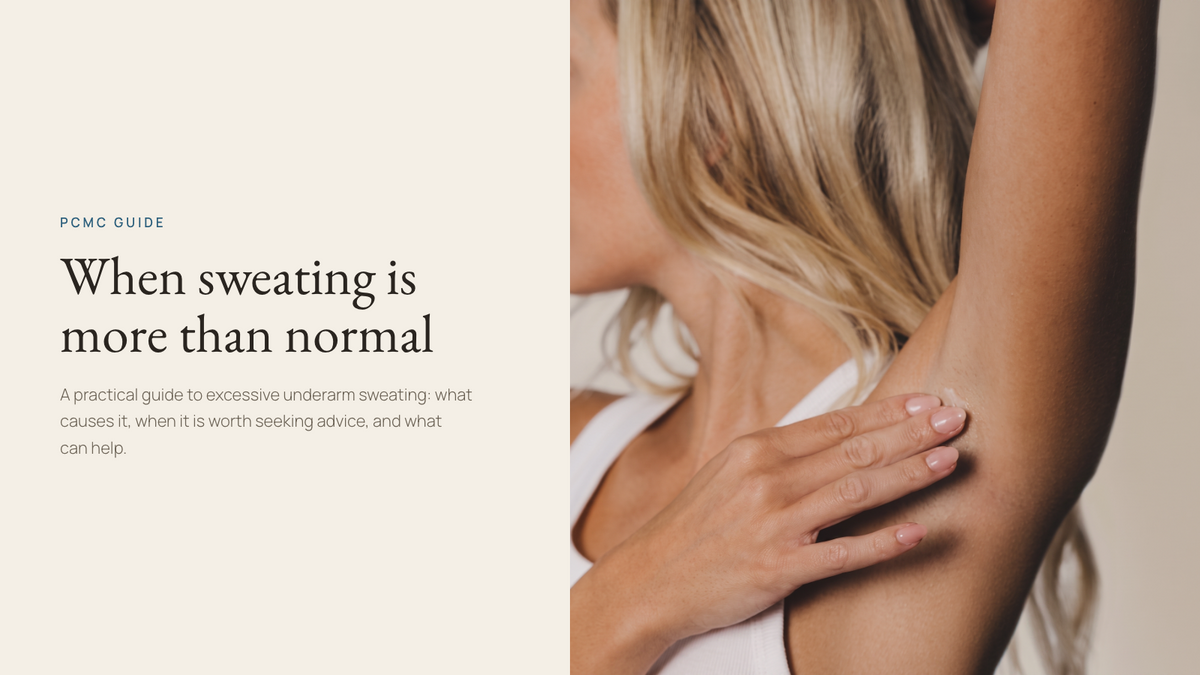
Excessive Underarm Sweating: When It’s More Than Normal and What Can Help
Sweating is normal. It is one of the ways our body regulates temperature and prevents us from overheating.
But how much we sweat varies enormously from person to person.
For some people, sweating goes well beyond what feels normal. It can mean regularly sweating through clothing, choosing what to wear around sweat marks, avoiding raising your arms, or finding yourself thinking about perspiration far more than you would like to.
When sweating begins to affect everyday life, it may be hyperhidrosis.
It can be uncomfortable, frustrating and surprisingly disruptive. The good news is that there are treatment options.
What is hyperhidrosis?
Hyperhidrosis is the medical term for excessive, difficult-to-control sweating.
There isn't one amount of sweat that defines what is “too much”. For us, a more useful question is whether sweating is interfering with your quality of life.
Hyperhidrosis can be localised, affecting particular areas such as the underarms, hands, feet or face. Or it can be generalised, affecting more of the body.
It can also be primary or secondary.
Primary hyperhidrosis often begins in childhood or adolescence. It commonly affects areas such as both underarms, palms or soles and often settles during sleep. There isn't an underlying medical condition causing it. The signalling that activates the sweat glands is simply more active than it needs to be.
Secondary hyperhidrosis is different. It can be related to another medical condition or, in some cases, medication.
That distinction is important.
If your sweating has started suddenly, changed significantly, wakes you at night, affects much of your body or occurs with other unexplained symptoms, it should be medically assessed rather than simply treated as excessive sweating.
How much sweating is “too much”?
Think less about measuring the amount and more about how much it affects your day.
Underarm hyperhidrosis might mean:
- regularly sweating through shirts or tops
- changing clothes during the day
- avoiding certain colours or fabrics
- worrying about visible sweat marks
- feeling uncomfortable at work or socially
- avoiding raising your arms
- irritation or chafing from persistently damp skin
For many people, it isn't only the sweating itself.
It is the planning around it.
An important meeting, presentation or social situation can become stressful because you are already thinking about whether you might sweat. That additional anxiety can then become another trigger.
Some people describe knowing that the sweating is starting and feeling unable to stop it.
This can be particularly difficult for teenagers and younger people, when school, sport, presentations and social confidence are already such a big part of everyday life.
Why do my underarms sweat so much?
Sweat glands are part of the body's normal temperature-control system.
Sweating can be triggered by things such as:
- heat
- exercise
- fever
- spicy food
- anxiety or stress
With primary hyperhidrosis, sweating can also happen without an obvious trigger.
That is why simply being told to “use a stronger deodorant” isn't always especially helpful.
Deodorant vs antiperspirant: what's the difference?
They do different jobs.
A deodorant primarily helps manage odour. It does not significantly reduce the amount you sweat.
An antiperspirant is designed to reduce sweating. Aluminium-based antiperspirants temporarily reduce the flow of sweat and are often one of the first things people try for excessive underarm sweating.
Different strengths are available, although stronger formulations can sometimes irritate the skin.
You may also have heard concerns about aluminium-containing antiperspirants and breast cancer. Current evidence has not established a link between antiperspirant use and breast cancer.
For mild sweating, antiperspirants and a few practical changes may be enough.
When sweating continues to interfere with daily life despite these measures, it can be worth looking at other options.
What treatments are available for excessive sweating?
There isn't one treatment that is right for everybody.
The appropriate approach depends on where you sweat, how severe it is, how it affects you and whether there could be an underlying cause.
Treatment options can include:
- stronger or clinical-strength antiperspirants
- selected topical or oral medications
- iontophoresis, commonly used for excessive sweating of the hands and feet
- botulinum toxin injections for localised sweating
- selected energy-based procedures
- surgery in severe cases
At PCMC, one of the treatment options we offer for primary excessive underarm sweating is botulinum toxin type A.
How does botulinum toxin reduce underarm sweating?
Botulinum toxin is well known for its use in cosmetic medicine, but it also has a recognised medical role in treating excessive underarm sweating.
Sweat glands are activated by signals travelling from the nerves.
Botulinum toxin treatment temporarily reduces those signals in the treated area, which in turn reduces sweat production.
In New Zealand, BOTOX® is registered for the treatment of primary hyperhidrosis of the axillae, or excessive sweating of the underarms.
The aim isn't necessarily to eliminate every trace of sweat. It is to reduce excessive sweating to a level that feels much more normal and manageable.
Because treatment is localised to the underarms, it does not remove the body's overall ability to sweat and regulate temperature.
What happens during an underarm treatment?
The first step at PCMC is a consultation.
We will talk about how much you are sweating, when it happens, how it affects you, your medical history and whether there could be another reason for the sweating.
Before treatment, we may use a starch iodine test, also known as the Minor test, to help identify exactly where excessive sweating is occurring.
Iodine is applied to the underarm and allowed to dry before a light layer of starch is added. Areas where sweating is active change to a dark blue or purple colour, helping your clinician map the area that needs to be treated.
Once the treatment area has been identified, a series of small, shallow injections is placed across the underarm skin, around the sweat glands.
The treatment itself is relatively quick. Your appointment also allows time for assessment, preparation and a discussion about what to expect afterwards.
Does underarm Botox hurt?
There are a number of small injections, so you will feel them.
At PCMC we use very fine 34-gauge TSK needles for this treatment to help make the injections as comfortable as possible.
Most people tolerate the treatment well, although everyone experiences injections differently.
Temporary tenderness, redness, swelling or bruising can occur at the injection sites.
When will I notice less sweating?
The result develops gradually rather than immediately.
You may begin to notice a reduction in sweating within the first week, with the effect continuing to develop over the following days.
Your PCMC clinician will talk you through when to expect the result and whether any follow-up is needed.
How much will my sweating reduce?
This varies from person to person.
The aim is a meaningful reduction in excessive sweating, not a promise that you will never sweat under your arms again.
Typically, the treated area becomes noticeably drier following treatment. Over time the effect gradually wears off and sweating returns towards its previous level.
A small number of people may notice more sweating elsewhere, although this is uncommon.
We prefer to talk about what a good result might look like for you, rather than promising a particular percentage of sweat reduction.
How long does treatment last?
Botulinum toxin treatment is temporary, and duration varies from person to person.
At PCMC, many patients find the reduction in sweating lasts around six to nine months, although some experience a shorter or longer duration.
New Zealand BOTOX® clinical data also shows that the effect can last well beyond the first few months. In clinical studies, 82% of treated patients were still responding at 16 weeks. Among patients who went on to have repeat treatment, the average time before requesting retreatment following their first treatment was around 33 weeks.
Some patients experience an effect lasting considerably longer.
There isn't a fixed timetable everyone needs to follow. Repeat treatment can be considered when the effect begins to wear off and excessive sweating starts to become bothersome again.
Is underarm botulinum toxin treatment suitable for everyone?
No.
Botulinum toxin is a prescription medicine and treatment requires a medical assessment.
There are circumstances where it may not be suitable, including certain neuromuscular conditions, infection at the proposed treatment site and previous hypersensitivity to botulinum toxin.
Pregnancy, breastfeeding, medication and other aspects of your health also need to be discussed with your clinician.
And importantly, if there is reason to think your excessive sweating could be caused by another medical condition, that needs to be considered first.
When should excessive sweating be medically investigated?
Most primary hyperhidrosis follows a long-standing and relatively familiar pattern.
But sweating can sometimes be a sign of something else.
Seek medical advice if your sweating:
- has started suddenly or changed significantly
- affects much more of your body than one localised area
- regularly occurs during sleep
- is noticeably different on one side of your body
- began after starting or changing medication
- occurs with other unexplained symptoms
If you are unsure, talk to your GP or contact the PCMC team.
You don't necessarily have to just live with it
Because everybody sweats, excessive sweating can be easy to dismiss.
But if it is deciding what you wear, affecting how comfortable you feel around other people, interrupting your day or simply taking up too much mental space, it is worth talking about.
At PCMC, we can look at what is happening, how it is affecting you and whether treatment is appropriate.
As with so much of what we do, the starting point is understanding the concern properly first.
Then we can work out what makes sense for you.
September at PCMC
Underarm treatment for excessive sweating
PCMC offers medically administered BOTOX® treatment for primary excessive underarm sweating.
$900 for both underarms, including consultation and treatment.
If excessive sweating is affecting what you wear, how you work or how comfortable you feel day to day, talk to the PCMC team about whether treatment may be appropriate for you.
Book a consultation with PCMC in Ponsonby, Auckland.
Frequently asked questions about excessive underarm sweating
What is hyperhidrosis?
Hyperhidrosis is excessive, difficult-to-control sweating. It can affect specific areas such as the underarms, palms, feet or face, or it can affect more of the body.
Why do my underarms sweat even when I am not hot?
With primary hyperhidrosis, the signalling that controls the sweat glands can be overactive, meaning sweating may occur even when your body does not need additional cooling.
Is excessive underarm sweating a medical condition?
It can be. Excessive, difficult-to-control sweating is known medically as hyperhidrosis. Because sweating can sometimes be related to another medical condition or medication, new or unusual symptoms should be medically assessed.
How does Botox help underarm sweating?
Botulinum toxin temporarily reduces the nerve signalling that activates sweat glands in the treated area. BOTOX® is registered in New Zealand for primary axillary hyperhidrosis.
How quickly does treatment work?
A reduction in sweating can begin within the first week, with the result continuing to develop over the following days. Individual responses vary.
How long does treatment last?
Results are temporary and vary between people. At PCMC, many patients experience a reduction in excessive sweating for around six to nine months, although the effect can be shorter or longer.
Is there downtime after underarm Botox?
Temporary tenderness, redness, swelling or bruising can occur around the injection sites. Your clinician will give you individual aftercare advice.
Can excessive sweating be caused by something else?
Yes. Some medical conditions and medicines can cause secondary hyperhidrosis. New or generalised sweating, night sweating or a significant change in your usual pattern should be medically assessed.
Mandatory medicine information
Botox ®️ , Prescription Medicine
For the treatment of forehead lines, frown lines and crow's feet round the eyes. Also for the treatment of migraine headaches, platysma muscle prominence and underarm hyperhidrosis.
Botox ®️ has risks and benefits. Ask your doctor if Botox is right for you
Botulinum toxin type A 50, 100, 200 Units.
For product information check with your doctor or Consumer Medicine Information on www.medsafe.govt.nz
Allergan, Auckland.